
Treat the root cause of Meibomian Gland Disease associated dry eye disease with the TearCare® System
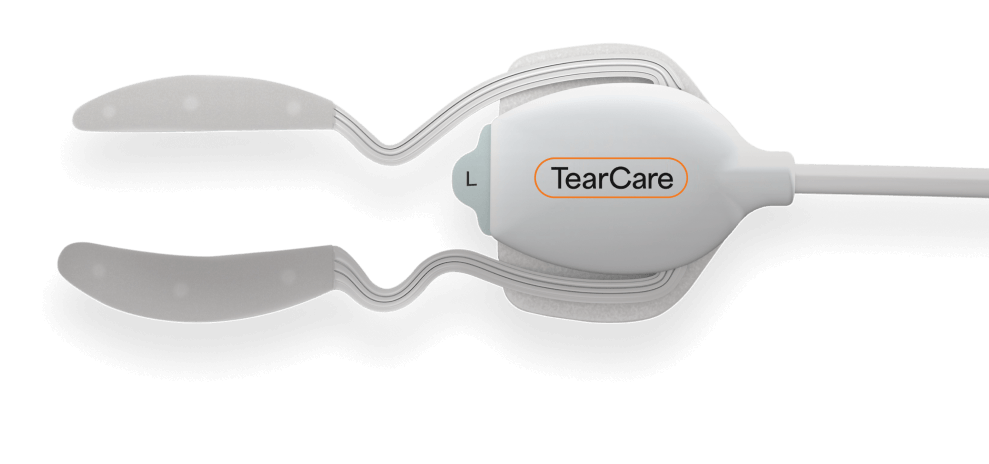

A Therapy for Dry Eye Caused by Meibomian Gland Disease
TearCare targets the leading cause of dry eye disease by directly addressing meibomian gland dysfunction.
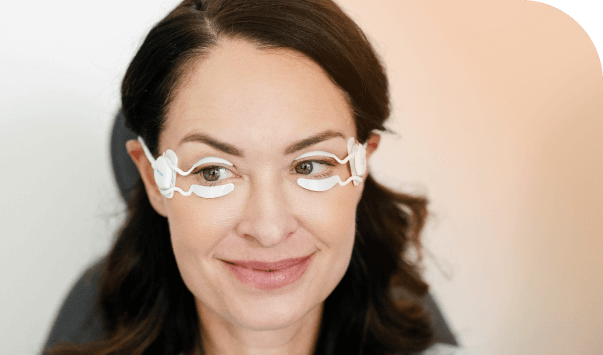
It works by applying localized heat therapy through a flexible, gentle design that allows patients to blink naturally.
Better Eye Health with Early Intervention
- Better Outcomes TearCare has demonstrated significantly better outcomes1,2,3,4,5 compared with the leading prescription competitor, with a more convenient patient experience.
- Procedural Intervention With results beginning in one week7 and lasting up to one year.8 TearCare improves gland function for long-term success.8,9

Replace months of drops with a single treatment.11 Improve outcomes.

Act with confidence on behalf of your patients’ eye health. Learn More about the TearCare system today.
Contact Us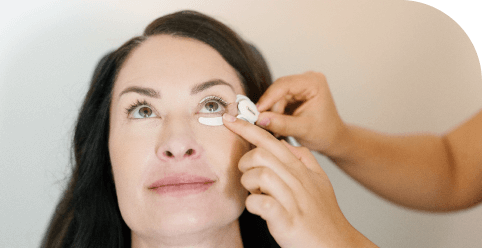
We Blink 15,000 Times a Day
Every blink relies on as few as 20 meibomian glands per eyelid to maintain healthy tear function. 12
- Early intervention Matters
- MGD starts in an asymptomatic stage
- Atrophy is irreversible14,15,16
- Proven Earlier Intervention
- Unsurpassed symptom improvement compared to leading Rx brand in TBUT and MG function10
- Equal to the leading Rx brand in all other categories while minimizing the drawbacks of poor compliance10,11
- Ten peer-reviewed publications demonstrating efficacy and safety
- A Better Patient Experience
- Eliminate the burden of prescription daily drops 11
- Reduction in medication compliance challenges
- Comfortable in-office therapy
- A New Order in Care
- Effective therapy can be started earlier in the disease state
- Proactive intervention superior to the #1 dry eye prescription medication 10
- Act before atrophy
- Comprehensive Therapy
- Comfortable open-eye therapy
- Our expert thermal technology combined with your expert hands

TearCare Reimbursement Just Got Real.
1. Holland, E. J., Loh, J., Bloomenstein, M., Thompson, V., Wirta, D., & Dhamdhere, K. (2022). A Comparison of TearCare and Lipiflow Systems in Reducing Dry Eye Disease Symptoms Associated with Meibomian Gland Disease. Clinical ophthalmology (Auckland, N.Z.), 16, 2861–2871. https://doi.org/10.2147/OPTH.S368319
2. Gupta, P. K., Holland, E. J., Hovanesian, J., Loh, J., Jackson, M. A., Karpecki, P. M., & Dhamdhere, K. (2022). TearCare for the Treatment of Meibomian Gland Dysfunction in Adult Patients With Dry Eye Disease: A Masked Randomized Controlled Trial. Cornea, 41(4), 417–426. doi: https://doi.org/10.1097/ico.0000000000002837
3. Chester T. A Single – center Retrospective Trial of a Blink – assisted Eyelid Device in Treating the Signs and Symptoms of Dry Eye. Optometry and Vision Science. 2021;98(6):605 – 612. doi: https://doi.org/10.1097/opx.0000000000001711
4. Badawi D. (2018). A novel system, TearCare®, for the treatment of the signs and symptoms of dry eye disease. Clinical ophthalmology (Auckland, N.Z.), 12, 683–694. https://doi.org/10.2147/OPTH.S160403
5. Badawi D. TearCare® system extension study: evaluation of the safety, effectiveness, and durability through 12 months of a second TearCare® treatment on subjects with dry eye disease. Clinical Ophthalmology. 2019; Volume 13:189-198. doi: https://doi.org/10.2147/opth.s191588
6. Chester, T., Longo, R., Masseria, C., Riley, P., Patel, C., & Mody, L. (2025). Budget impact analysis (BIA) of the TearCare System for the treatment of meibomian gland dysfunction (MGD)-associated dry eye disease (DED) in the United States (US). Expert Review of Ophthalmology, 20(1), 55–61. https://doi.org/10.1080/17469899.2024.2444930
7. Karpecki, P., Wirta, D., Osmanovic, S., & Dhamdhere, K. (2020). A Prospective, Post-Market, Multicenter Trial (CHEETAH) Suggested TearCare® System as a Safe and Effective Blink-Assisted Eyelid Device for the Treatment of Dry Eye Disease. Clinical ophthalmology (Auckland, N.Z.), 14, 4551–4559. https://doi.org/10.2147/OPTH.S285953
8. Chester, T., Ferguson, T., & Chester, E. (2023). Localized Heat Treatment for Meibomian Gland Dysfunction: A Single-Center Retrospective Analysis of Efficacy over Time. Optometry and vision science : official publication of the American Academy of Optometry, 100(9), 625–630. https://doi.org/10.1097/OPX.0000000000002053
9. Blackie CA, et al. Treatment for meibomian gland dysfunction and dry eye symptoms with a single-dose vectored thermal pulsation: a review. Curr Opin Ophthalmol. 2015 Jul;26(4):306-13.
10. Ayres BD, Bloomenstein MR, Loh J, et al. A Randomized, Controlled Trial Comparing Tearcare® and Cyclosporine Ophthalmic Emulsion for the Treatment of Dry Eye Disease (SAHARA).Clinical Ophthalmology (Auckland, NZ). 2023;17:3925-3940. https://doi.org/10.2147/OPTH.S442971. At 6 months TearCare was superior to Restasis in improving Tear Breakup Time (TBUT) and multiple measures of meibomian gland function and was non-inferior in Ocular Surface Disease Index (OSDI), and all remaining signs and symptoms.
11. Ayres, B. D., Bloomenstein, M. R., Loh, J., Chester, T., Saenz, B., Echegoyen, J., Kannarr, S. R., Rodriguez, T. C., & Dickerson, J. E., Jr (2024). Improved Signs and Symptoms of Dry Eye Disease for Restasis® Patients Following a Single Tearcare® Treatment: Phase 2 of the SAHARA Study. Clinical ophthalmology (Auckland, N.Z.), 18, 1525–1534. https://doi.org/10.2147/OPTH.S464379
12. Tomlinson A, et al. The international workshop on meibomian gland dysfunction: report of the diagnosis subcommittee. Invest Ophthalmol Vis Sci. 2011 Mar 30;52(4):2006-49.
13. Hovanesian J, et al. Durability of the TearCare treatment effect in subjects with dry eye disease: Stage 3 of the Sahara randomized controlled trial. Optom Vis Sci. 2025 Aug 1;102(8):495-504.
14. Liu S, Richards SM, Lo K, Hatton M, Fay A, Sullivan DA. Changes in gene expression in human meibomian gland dysfunction. Investigative Ophthalmology & Visual Science. 2011 Apr;52(5):2727–2740.
15. Fins D, Ackerman P, et al. Evaluation of Meibomian Gland Dysfunction and Local Distribution of Meibomian Gland Atrophy by Non-contact Infrared Meibography. Current Eye Research. 2015;40(10):982–989.
16. Gutgesell VJ, Stern GA, Hood CI. Histopathology of meibomian gland dysfunction. Am J Ophthalmol. 1982 Sep;94(3):383-7
17. Hovanesian J, Ayres BD, Bloomenstein MR, Loh J, Chester T, Saenz B, Echegoyen J, Kannarr SR, Rodriguez TC, Dickerson JE Jr. Durability of the TearCare treatment effect in subjects with dry eye disease: Stage 3 of the Sahara randomized controlled trial. Optom Vis Sci. 2025 Aug 1;102(8):495-504.